
358 Anti-Climb Fence: Full Specification, Standards and Buying Guide
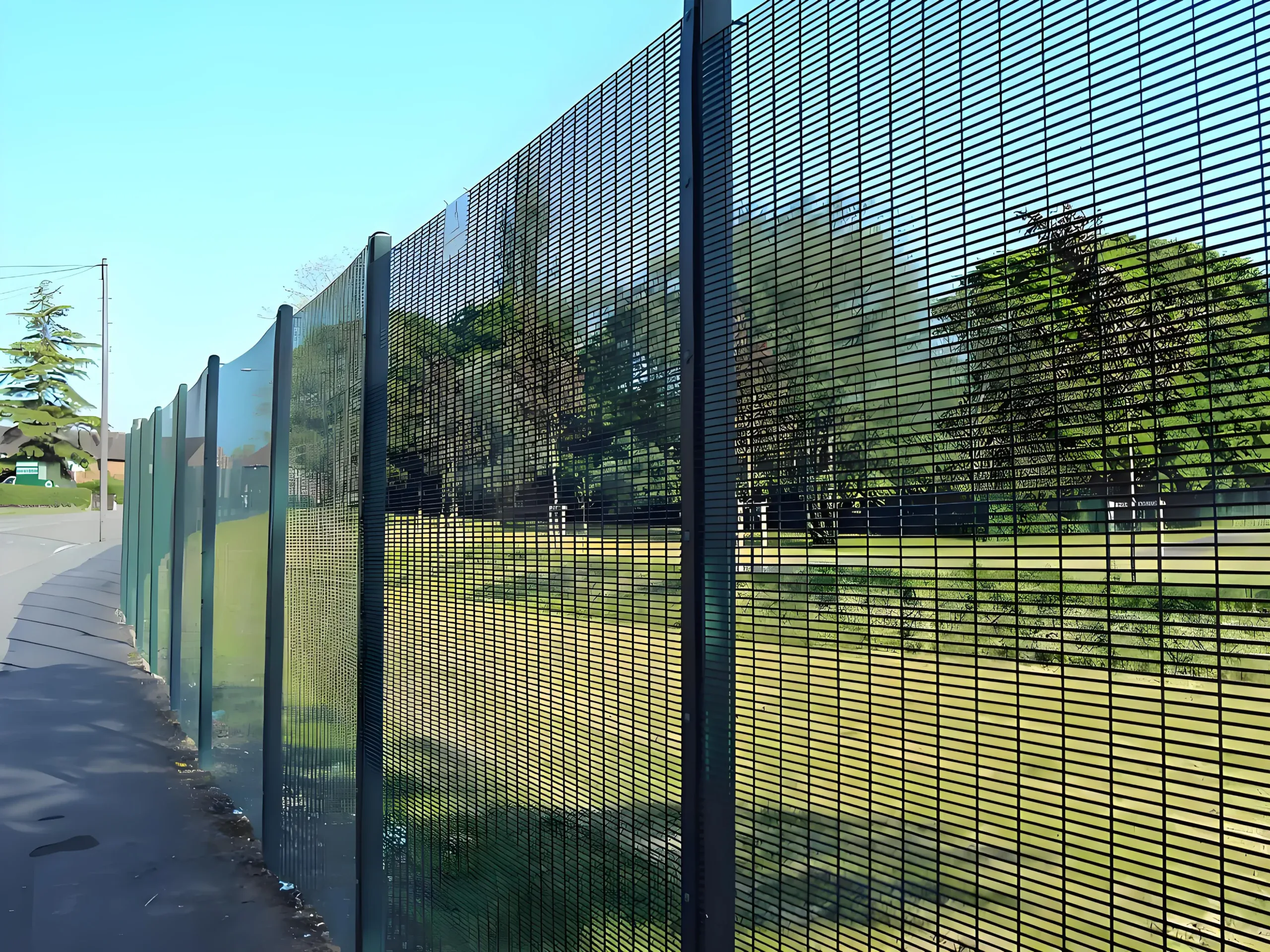
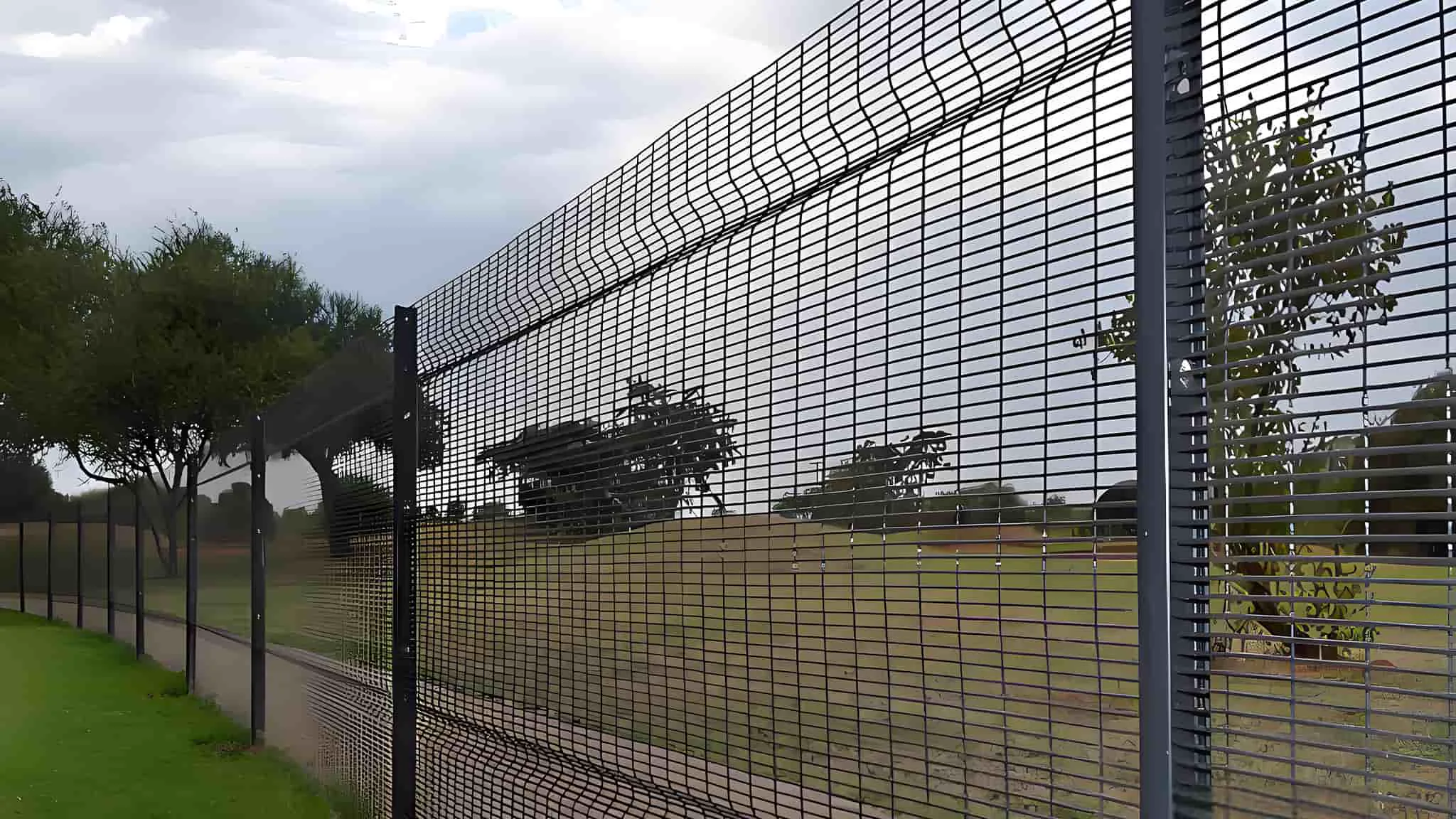
Quick answer: A 358 fence is a high-security welded steel mesh fence with a 76.2 mm × 12.7 mm (3″ × 0.5″) rectangular aperture made from 4.0 mm (8 gauge) wire. The aperture is too narrow to admit a finger or the toe of a boot, which makes the panel effectively unclimbable without tools, and the 4.0 mm wire at a welded intersection resists hand-held bolt cutters.
It is the default perimeter specification for prisons, airports, substations, data centres and military sites. Panels are typically 2515 mm wide and supplied in heights from 2.0 m to 6.0 m.
What does “358” actually mean?
The number is a dimensional code taken from imperial measurements:
- 3 — 3 inches (76.2 mm), the long side of the mesh aperture
- 5 — 0.5 inches (12.7 mm), the short side of the aperture
- 8 — 8 gauge (≈ 4.0 mm), the wire diameter
So “358” reads as 3″ × 0.5″ × 8 gauge, or 76.2 × 12.7 × 4.0 mm in metric.
Several fencing sites claim the “5” refers to the “twisting degree of the mesh” and the “8” to a wire-to-spacing ratio. This is incorrect. 358 mesh is welded, not twisted or woven — there is no twist to describe. The three digits are simply aperture length, aperture width, and wire gauge. If a supplier explains 358 any other way, treat it as a signal that they are reselling rather than manufacturing.
The same naming logic produces the sister products: 3510 is the same 3″ × 0.5″ aperture in lighter 10-gauge wire, and 868 or 656 describe twin-wire panels by their wire diameters (8-6-8 mm and 6-5-6 mm) rather than by aperture.
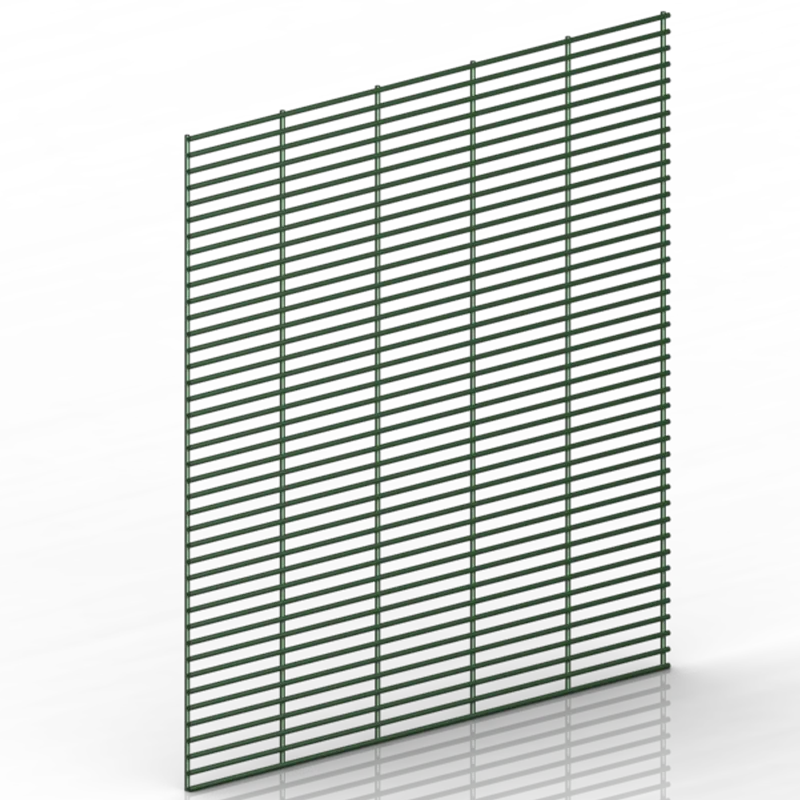
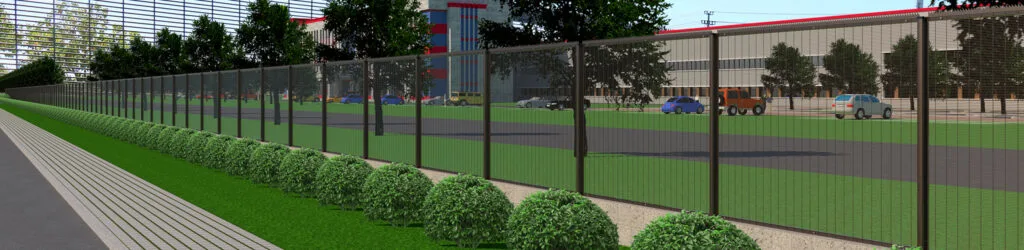
358 fence specification table
| Parameter | Standard value | Available range |
|---|---|---|
| Mesh aperture | 76.2 × 12.7 mm (3″ × 0.5″) | Fixed by definition |
| Wire diameter | 4.0 mm (8 SWG) | 3.0–4.0 mm (3.0 mm = 3510 variant) |
| Panel width | 2515 mm | 2515 / 3000 mm |
| Panel height | 2400 mm | 1800 / 2000 / 2400 / 3000 / 3600 / 4000 / 5000 / 6000 mm |
| Panel weight | ≈ 34 kg @ 2.4 m | Scales with height |
| Wire tensile strength | 450–550 MPa | Up to 700 MPa on request |
| Weld shear strength | ≥ 3.5 kN per intersection | — |
| Post section | 80 × 60 mm RHS, 2.0–3.0 mm wall | 60×60 / 80×60 / 100×100 / 120×120 SHS·RHS |
| Post spacing | 2565 mm centres | Matched to panel width |
| Fixing | M8 anti-tamper shear-nut | Shear nut, clamp bar, or panel-through bolt |
| Base coat | Hot-dip galvanized, 60–80 µm | Pre-galv 275 g/m² · HDG to ASTM A123 / EN ISO 1461 |
| Top coat | Polyester powder, 60–100 µm | PVC-coated as alternative |
| Standard colours | RAL 6005 Moss Green · RAL 9005 Jet Black | RAL 7016, RAL 6009, any RAL to order |
| Panel deflection | < 25 mm under 1 kN point load | At mid-span |
Command Fence supplies 358 in four build codes — 2DG, 2DF, 3DG and 3DF — differing in post profile and fixing system. See the 358 Metal Fence product page for the model-by-model breakdown.
Why 358 defeats climbing and cutting
Security fencing fails in three ways: someone climbs it, cuts it, or lifts the bottom and crawls under. 358 addresses all three geometrically, not by adding hardware.
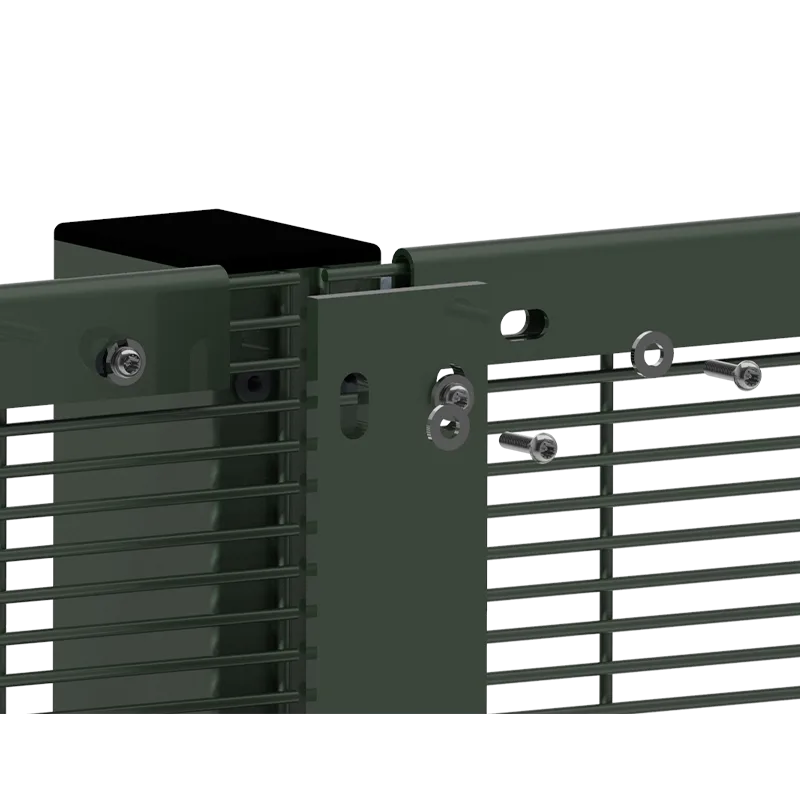
Against climbing. A 12.7 mm gap admits neither a fingertip pad nor a boot welt. An adult needs roughly 25 mm of purchase for a finger hold and 35 mm for a toe hold — the climb-resistance requirements for this panel category are set in BS 1722-14:2017. The panel offers 12.7 mm. Unlike chain link, there is no diamond aperture to wedge a foot into, and unlike palisade, there are no vertical pales to grip. The climber has nothing to load.
Against cutting. Bolt cutters need jaw clearance around the wire. The 12.7 mm gap physically blocks a standard 600 mm bolt cutter jaw from seating on the vertical wire, so an attacker must work from the horizontal wire — where 4.0 mm of steel at 450–550 MPa demands sustained effort per cut, and a man-sized breach requires 15–25 cuts. Attack-tested variants push this beyond the LPS 1175 delay thresholds (Issue 8 ratings B3 / C5, formerly SR2 / SR3 — verifiable in the LPCB Red Book).
Against under-crawl. Because panel wires are rigid and welded, the bottom edge cannot be lifted the way chain-link fabric can. Standard practice is to set the panel 50 mm above finished grade on a concrete kerb or ground beam; on soft ground, specify a buried panel extension or an anti-dig plate.
A fourth advantage — surveillance. The aperture is narrow but the fence is see-through. Guards and CCTV keep an unbroken sightline through the perimeter, and the fence itself casts no shadow for an intruder to hide in. Solid walls and welded palisade both surrender this.
358 compared with the alternatives
| 358 anti-climb | 3510 | 868 twin wire | Chain link | Steel palisade | |
|---|---|---|---|---|---|
| Aperture | 76.2 × 12.7 mm | 76.2 × 12.7 mm | 200 × 50 mm | 50–60 mm diamond | 100–150 mm pale gap |
| Wire / section | 4.0 mm | 3.0–3.2 mm | 8/6/8 mm | 2.5–4.0 mm | 3 mm pressed pale |
| Climb resistance | Very high | High | Medium | Low | Medium |
| Cut resistance | Very high | High | High | Low | Medium |
| Through-visibility | Excellent | Excellent | Good | Good | Fair |
| Rigidity | Very high | High | Very high | Low | High |
| Relative cost | 100 % | 70–80 % | 60–70 % | 20–30 % | 55–70 % |
| Typical use | Prison, airport, substation, data centre | Commercial, schools, retail parks | Industrial, logistics, sports | Demarcation, temporary | Utilities, industrial estates |
How to choose in one line: if the threat model includes a determined human attacker with hand tools, specify 358. If the requirement is demarcation and deterrence against opportunists, 3510 or 868 delivers most of the effect at 60–80 % of the cost.
Height selection by application
| Height | Application | Usual top detail |
|---|---|---|
| 1.8–2.0 m | Schools, retail parks, commercial boundaries | Plain top |
| 2.4 m | Industrial sites, warehouses, car parks | Plain or 3-line barbed extension |
| 3.0 m | Substations, telecom sites, water treatment, data centres | 45° cranked arm + razor coil |
| 3.6–4.0 m | Airports, ports, rail depots | Cranked arm + concertina, detection cable |
| 5.0–6.0 m | Prisons, military installations, high-value storage | Double fence, sterile zone, razor coil, PIDS |
For prison and airport work, height is set by the governing authority's standard, not by the supplier. Confirm the controlling document — often BS 1722-14:2017, a national aviation regulator's spec, or a client-specific security manual — before pricing.
Coatings and realistic service life
The number that matters is coating thickness and process, not the word “galvanized.”
- Pre-galvanized wire, then welded — zinc is burned away at every weld intersection. Cheapest option, and the weld points are the first thing to rust. Acceptable only in dry inland climates.
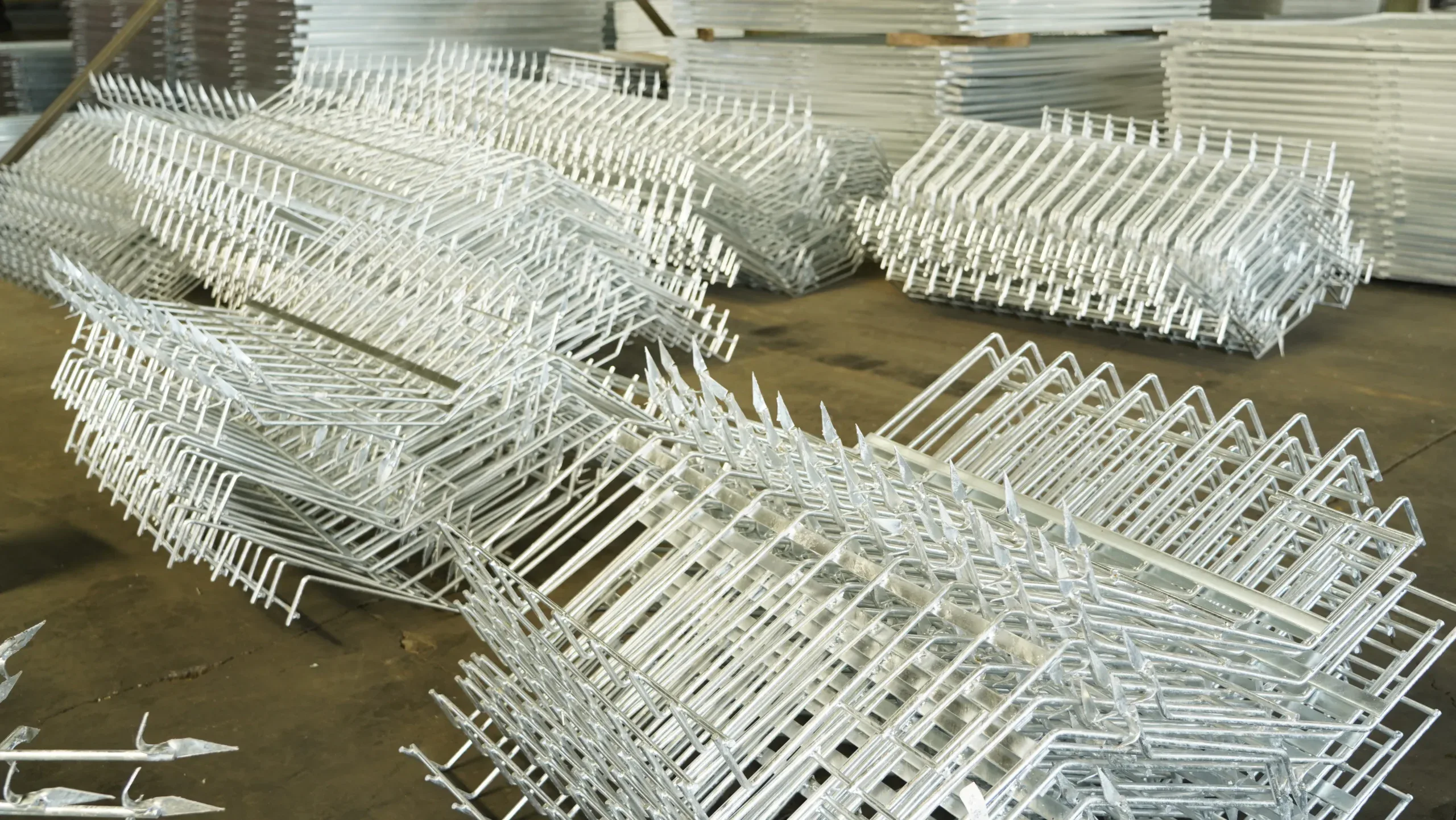
- Welded, then hot-dip galvanized (HDG) to ASTM A123 / ISO 1461:2022 — the whole panel including weld nodes is coated at 60–80 µm. This is the correct baseline for any project expected to last.
- Duplex: HDG + polyester powder coat — zinc handles the electrochemistry, powder handles UV and abrasion, and the combination outlasts the sum of its parts because the powder layer slows zinc consumption.
| Environment | HDG only | Duplex (HDG + powder) |
|---|---|---|
| Dry inland / desert | 30+ years | 40+ years |
| Temperate urban | 20–25 years | 30+ years |
| Industrial / high SO₂ | 10–15 years | 20–25 years |
| Coastal, within 1 km of surf | 8–12 years | 15–20 years |
For coastal, port and island projects — a large share of shipments to Kenya, Chile and the Philippines fall in this band — always specify duplex and increase post wall thickness to 3.0 mm. The saving from skipping duplex is roughly 12–18 % of panel cost; the cost of early replacement is 100 % plus installation.
Posts, fixings and installation notes
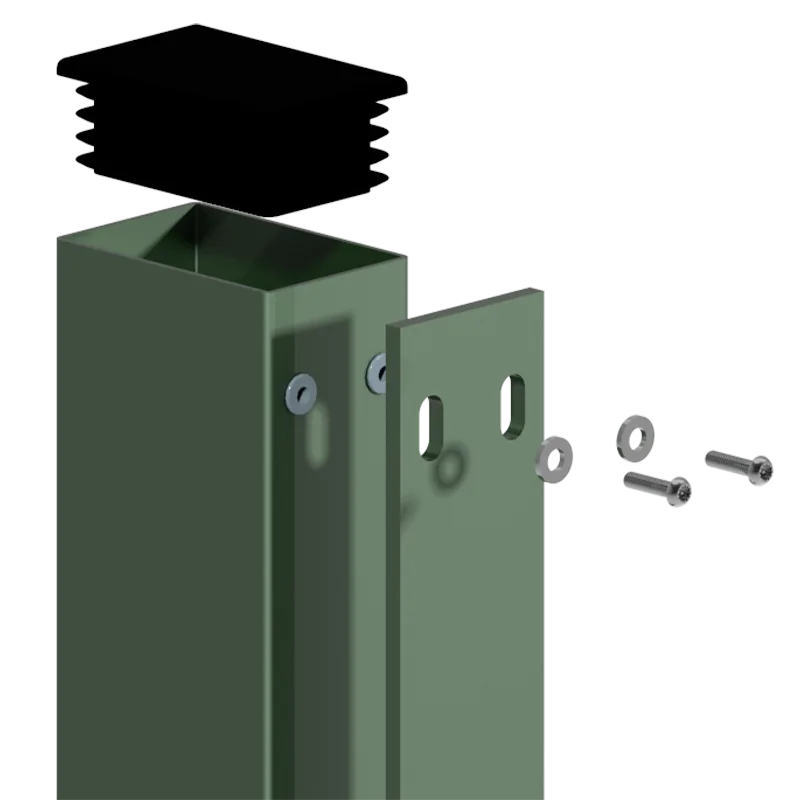
Post selection. 80 × 60 mm RHS at 2.0 mm wall is standard to 2.4 m. Above 3.0 m, or in any location with design wind speed above 40 m/s, move to 100 × 100 mm at 3.0 mm wall. The panel is stiff enough that wind load transfers almost entirely into the posts and foundations — under-specifying the post is the single most common failure mode in cheap 358 installations.
Foundations. Typical concrete pad 400 × 400 × 600 mm deep for a 2.4 m fence; 500 × 500 × 900 mm for 4.0 m and above. Increase depth in sand, peat or high water table. Straight-line runs need an intermediate straining post every 50 m.
Anti-tamper fixings are not optional. A 358 panel secured with standard M8 hex nuts can be removed with a spanner in under two minutes, which defeats the entire specification. Use shear nuts (the head snaps off at torque, leaving nothing to grip), clamp bars, or through-bolts with the thread deformed after tightening. Fix from the secure side wherever geometry allows.
Panel orientation. Install with the horizontal wires on the secure side and the vertical wires facing out. This removes even the marginal ledge that a horizontal wire presents to a climber.
Ground following. 358 panels can be raked to roughly 1:10 without stepping. Steeper than that, step the panels and infill the triangular gap at the base — never leave the gap, and never rake the panel beyond its raking limit, which twists the welds.
Standards to cite in tender documents
| Standard | Covers |
|---|---|
| BS 1722-14 | Open mesh steel panel fences — the primary UK/Commonwealth reference for 358 |
| ISO 1461:2022 / ASTM A123 | Hot-dip galvanized coatings on fabricated steel |
| EN 10346 | Continuously hot-dip coated steel sheet and strip |
| EN 10218 / ASTM A510 | Steel wire — general requirements and tolerances |
| LPS 1175 | LPCB attack-delay ratings — Issue 8 codes A1–H20 (formerly SR1–SR8) |
| ISO 9001 | Manufacturer quality management system |
| Secured by Design | UK police-preferred specification scheme |
Command Fence manufactures to SGS, ISO 9001, ASTM A123, EN 10346 and CE, with multi-stage QC across wire drawing, welding, galvanizing and coating.
What actually drives the price
Ranked by impact on a delivered square-metre cost:
- Steel wire rod price — the largest single input, and it moves. Quotes older than 30 days are indicative only.
- Coating system — duplex adds roughly 12–18 % over HDG alone.
- Panel height — cost per m² is broadly flat, but taller fences need heavier posts and larger foundations, so the installed cost per linear metre rises faster than height.
- Post specification — often 25–35 % of the material package; the place cheap suppliers cut.
- Freight and packing — panel geometry means a 40 HQ container is usually volume-limited before it is weight-limited; good stacking design is worth real money per m².
- Order volume — tooling and line setup amortise over the run; project-scale orders price materially better than trial quantities.
Indicative FOB China ranges (2026, verify at quote): 358 panel with HDG, 2.4 m — roughly US$18–28 per m². Duplex-coated — roughly US$22–34 per m². Posts, fittings, gates and freight are additional. These figures move with steel and zinc pricing — follow LME zinc and regional steel billet indices for the trend — treat them as budget-setting inputs, not a quotation.
Specification checklist for your RFQ
Send these ten lines and you will get comparable quotes instead of guesses:
- Total linear metres, plus a site drawing or coordinate list
- Fence height, and whether topping (barbed / razor / cranked arm) is required
- Aperture and wire diameter — confirm 76.2 × 12.7 × 4.0 mm, or state the variant
- Coating system — HDG only, or HDG + powder coat, with target microns
- RAL colour
- Post section, wall thickness and fixing type
- Number of gates, type, clear openings, and whether automation is required
- Ground conditions and design wind speed
- Destination port and Incoterm
- Governing standard or client security specification, if any
Skipping items 4, 6 and 8 is what produces quotes that look 30 % cheaper and arrive as a fence that fails in five years.
Five mistakes that cost money after installation
- Buying on panel price alone while the post spec is silent. Panels rarely fail. Posts and foundations do.
- Pre-galvanized wire in a coastal project. Weld nodes rust first, and the failure looks like a manufacturing defect long before it is a corrosion one.
- Standard nuts instead of anti-tamper fixings. Turns a high-security fence into a removable one.
- No anti-dig detail at the base. The most common real-world breach of a 358 perimeter is under it, not through it.
- Ordering gates late. Gate lead times exceed panel lead times. Specify them in the same RFQ or the fence sits complete with a hole in it.
Frequently asked questions
What is a 358 fence?
A welded steel mesh security fence with a 76.2 mm × 12.7 mm aperture in 4.0 mm wire, designed so the mesh offers no finger or foot hold and resists bolt-cutter attack. It is also called anti-climb fence or prison mesh.
Why is it called 358?
From its imperial dimensions: 3 inch × 0.5 inch aperture, 8 gauge wire.
Is 358 fence genuinely unclimbable?
Without tools and without an aid, yes for practical purposes — the aperture is below the threshold for a finger or toe hold. With a ladder, a vehicle, or an adjacent structure, any fence can be crossed. 358 is a delay and detection element within a system, not an absolute barrier. That is why high-security sites pair it with topping, clear zones and PIDS.
What is the difference between 358 and 3510 fence?
Identical aperture; the wire differs. 358 uses 4.0 mm (8 gauge), 3510 uses roughly 3.0–3.2 mm (10 gauge). 3510 costs 20–30 % less and suits commercial perimeters; 358 is the specification for prisons, airports and critical infrastructure.
What height 358 fence does a prison require?
Commonly 5.0–6.0 m, usually as a double fence with a sterile zone between, razor coil topping and a perimeter intrusion detection system. The controlling number comes from the corrections authority's own standard, not from the fence supplier.
How long does a 358 fence last?
Hot-dip galvanized: roughly 20–25 years to first maintenance in a temperate urban environment, 8–12 years within a kilometre of surf. Duplex HDG-plus-powder extends both figures by roughly 50 %.
Can 358 panels be installed on a slope?
Raked to about 1:10; steeper ground requires stepped panels with the base gap infilled.
How much does 358 fencing cost per metre?
Panel material is broadly US$18–34 per m² FOB depending on coating, before posts, gates and freight. Installed cost per linear metre varies too widely by country, ground conditions and labour rate for a single figure to be meaningful — price the material package first, then the civil works locally.
Does 358 fence come in colours?
Yes. RAL 6005 moss green and RAL 9005 jet black are stock; any RAL is available to order via polyester powder coating over the galvanized base.
Can I get 358 with a security rating?
Attack-tested configurations are certified under LPS 1175 Issue 8 to B3 and C5 (formerly SR2 and SR3; certificate number to be confirmed at quotation and checked against the LPCB Red Book). Certification applies to a complete tested system — panel, post, fixing and foundation — so a rating cannot be claimed for a panel bought loose and installed on someone else's posts.
Specify with a manufacturer, not a trader
Command Fence has manufactured engineered perimeter systems in Hengshui, Hebei for over 15 years, with 10,000+ tons of annual output shipped to more than 50 countries including Kenya, Chile and the Philippines. Every project is supported with CAD assistance, multi-stage QC across wire drawing, welding, galvanizing and powder coating, and export packing designed for sea freight.
Get a specification review and quotation
Email sales@commandfence.com · WhatsApp +86 177 0122 6188
Request a quote →Related: 358 Metal Fence · 3D Metal Fence · 2D Metal Fence · BRC Mesh · Trackless Cantilever Gate · Razor Wire
About the author
Command Fence Engineering Team — Senior Specification Engineer, Command Fence (Hengshui), 15+ years in engineered perimeter systems. Reviewed 2026-08-18; standard references updated to current editions (BS 1722-14:2017, ISO 1461:2022, LPS 1175 Issue 8).


