
Typhoon-Ready Perimeter Fencing: How to Specify a Fence That Survives Wind, Rain and Salt Air
 By Blade, Project Sales Specialist · 21 October 2026
Short version: a fence comes through a typhoon when the whole system was built for wind, not just the mesh. That means open mesh, posts and footings sized for the site, decent fixings, and galvanizing plus powder coat if you are anywhere near the sea.
Super Typhoon Rosal (Champi) entered the Philippine Area of Responsibility on 20 October with sustained winds of 185 km/h. If your site is in its path, follow PAGASA and your LGU’s advisories. The fence can wait.
After a big storm, the photos contractors send us tend to look alike: a fence line where one stretch is still standing and the next is lying in the mud. The question is always the same. Why did one part survive and the other fail?
Usually it comes down to five things: how much wind the fence catches, the posts, the footings, the connections, and corrosion. We go through each of them below and finish with a simple checklist for walking the fence line once the weather has cleared.
- Open mesh fences catch much less wind than solid hoardings, walls or fences covered with shade cloth.
- Most storm failures start at the posts, footings and connections, not in the mesh panels.
- Salt spray and standing water cause a second wave of damage through corrosion.
- Wind resistance belongs to the whole system on your site. A product name alone doesn’t give you a rating.
1. Why Perimeter Fences Fail in Strong Winds
Wind area: a sheet of shade cloth changes everything
Wind pressure goes up with the square of wind speed. With the simplified formula q ≈ 0.613 V², a 200 km/h gust (about 55.6 m/s) gives a dynamic pressure of roughly 1.9 kPa. Treat that as a reference number, not a design load. The real pressure on a fence depends on your local code, the terrain, gust factors and how solid the fence is.
This is where open mesh helps. On 358, 2D, 3D and chain link fences, most of the air goes through the openings instead of pushing on a solid face. The load isn’t zero, and some meshes are denser than others, but it’s a far better starting point than sheet-metal hoarding.
So the cheapest thing you can do before a storm: take down banners, shade cloth, dust screens and signs tied to the fence. With those still on, an open fence behaves like a sail.
Load path: from panel to soil
The wind hits the panels, the clamps and bolts pass the load to the posts, and the posts pass it into the footings and the soil. The fence is only as strong as the weakest step: a light post, wide spacing, a small footing, soil softened by days of rain, or a rusted clamp. Gates are a separate case. Gate posts take concentrated loads and need their own design, not the same post as the straight runs.
2. Specifying Fences for Typhoon-Prone Sites
Below are the standard options for our 358G anti-climb fence, next to what we would check for an exposed or typhoon-prone site. We make the panels and posts in our own factory, so post size, wall thickness, spacing, base plates and coating can all be changed to match your engineer’s numbers. The standard sizes are where the discussion starts.
| Component | 358G standard options | Confirm for typhoon-prone sites |
|---|---|---|
| Height | 1.5 / 2.0 / 2.5 / 3.0 m | Wind load on the full height plus any top extensions |
| Mesh | Ø4.0 or Ø4.5 mm wire, 76.5 (or 100) × 12.5 mm spacing | Wire diameter, panel stiffness, clamp strength |
| Posts | Cold-formed I-post 54.4 × 100 mm, 1.5 / 2.0 mm wall | Bending and deflection for your wind zone; heavier sections made to order |
| Post spacing | Set by panel module and installation drawings | Reduced spacing where calculations require it |
| Footings | Designed for site soil conditions | Depth, size, groundwater level, scour risk |
| Fixings | Purpose-made clamps and anti-theft bolts | Corrosion resistance and pull-out strength |
| Surface protection | Zinc 80–120 g/m² + polyester powder coat 100–120 μm; full hot-dip galvanizing (550 g/m²) available | Coating system matched to the site’s corrosion category and design life |
If you send us the site location or wind zone, fence length and height, terrain, preferred mesh, soil or footing conditions, anti-climb add-ons and the number of gates, we can come back with a proposal for posts, spacing, connections and coating. Your local structural engineer then signs off the final design.
3. The Second Challenge: Salt Air and Corrosion
Wind is only half of it. After the storm comes the sea spray, water standing around the post bases for days, and scratches from flying debris. Rust tends to start at the post bases, the welds, cut edges and under bolt heads. Often nobody notices until the next storm finds the weak spot.
For coastal projects we use two layers of protection:
- Hot-dip galvanizing after welding. We weld the panels first and galvanize afterwards, so the welds and cut ends get zinc too. The zinc keeps protecting the steel even where the top coat gets scratched. Standard 358G panels carry 80–120 g/m² of zinc. For the harshest sites we can hot-dip galvanize the complete component at 550 g/m².
- Electrostatic polyester powder coat. 100–120 μm on top of the zinc, UV resistant, in any RAL colour.
If your project calls for ISO 1461 or ASTM A123/A123M galvanizing, or ISO 9227 salt spray testing, put it in the purchase specification and we will quote and test to it.
- Is the steel galvanized before or after welding? (Ours is galvanized after welding.)
- What are the zinc and powder-coat thicknesses, and how are they measured?
- Can you provide test reports for the actual coating system and a written warranty?
4. After the Storm: A 10-Minute Fence Inspection Checklist
Wait until the authorities say it is safe to go out, and keep clear of fallen power lines and damaged gates. Then walk the whole fence line with a phone and photograph anything on this list:
- Posts: leaning, twisting or cracking at the base.
- Footings: cracked concrete, washed-out soil or exposed foundations.
- Panels: bent wires, broken welds or panels that have shifted.
- Fixings: missing or loose clamps, bolts and anti-theft connectors.
- Coating: scratches, blistering, red rust or standing water at the posts.
- Gates: moved gate posts, damaged tracks or hinges, stiff opening.
- Debris: branches, plastic sheeting and signs caught on the fence.
- Record: number each problem spot and note its length, height and quantity.
Small scratches can be touched up with a repair paint that matches the original coating. A bent post, a footing that has rotated or several failed connections is a different matter. Get that section inspected properly, because paint won’t fix a structural problem.
Found damage? Send us your photos and dimensions and we can supply matching replacement panels, posts and fixings.
5. Project Reference: Chancay Port, Peru
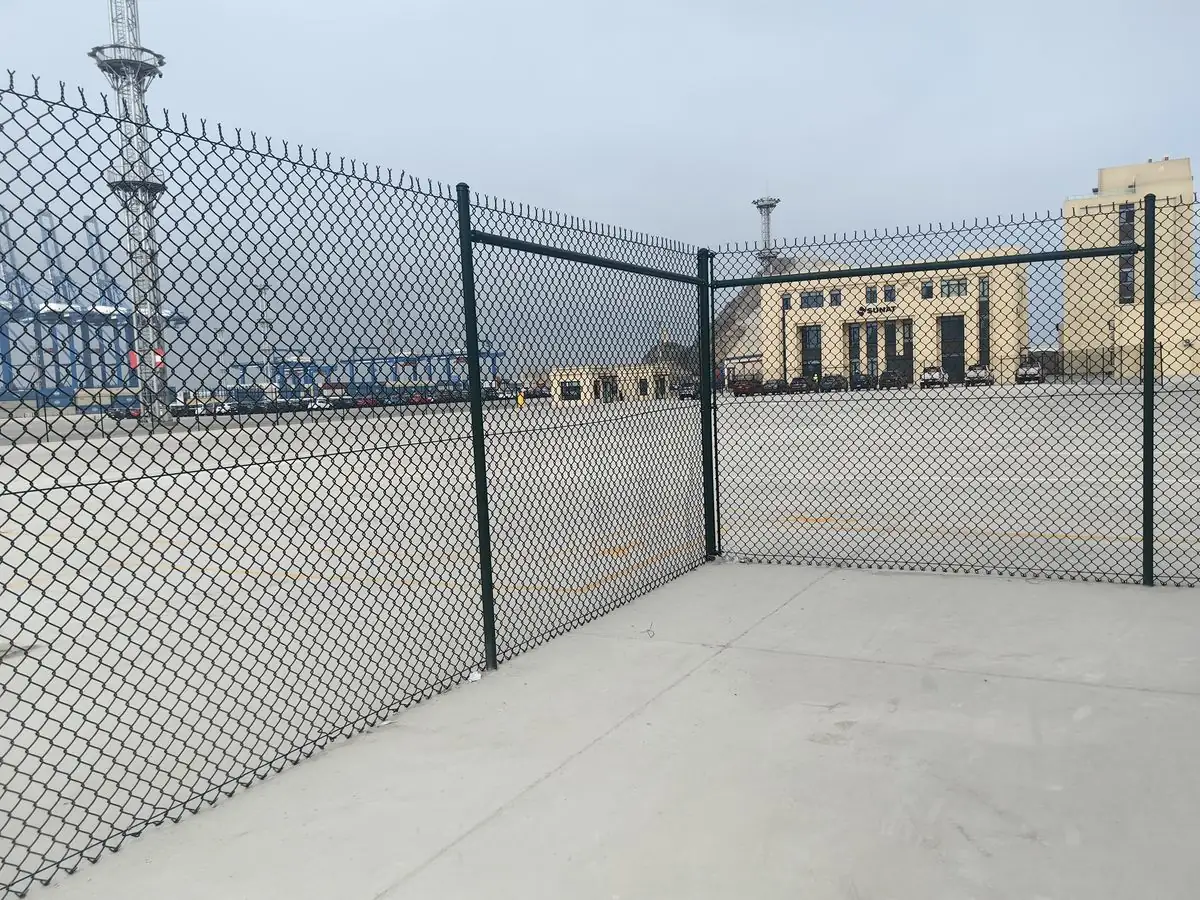
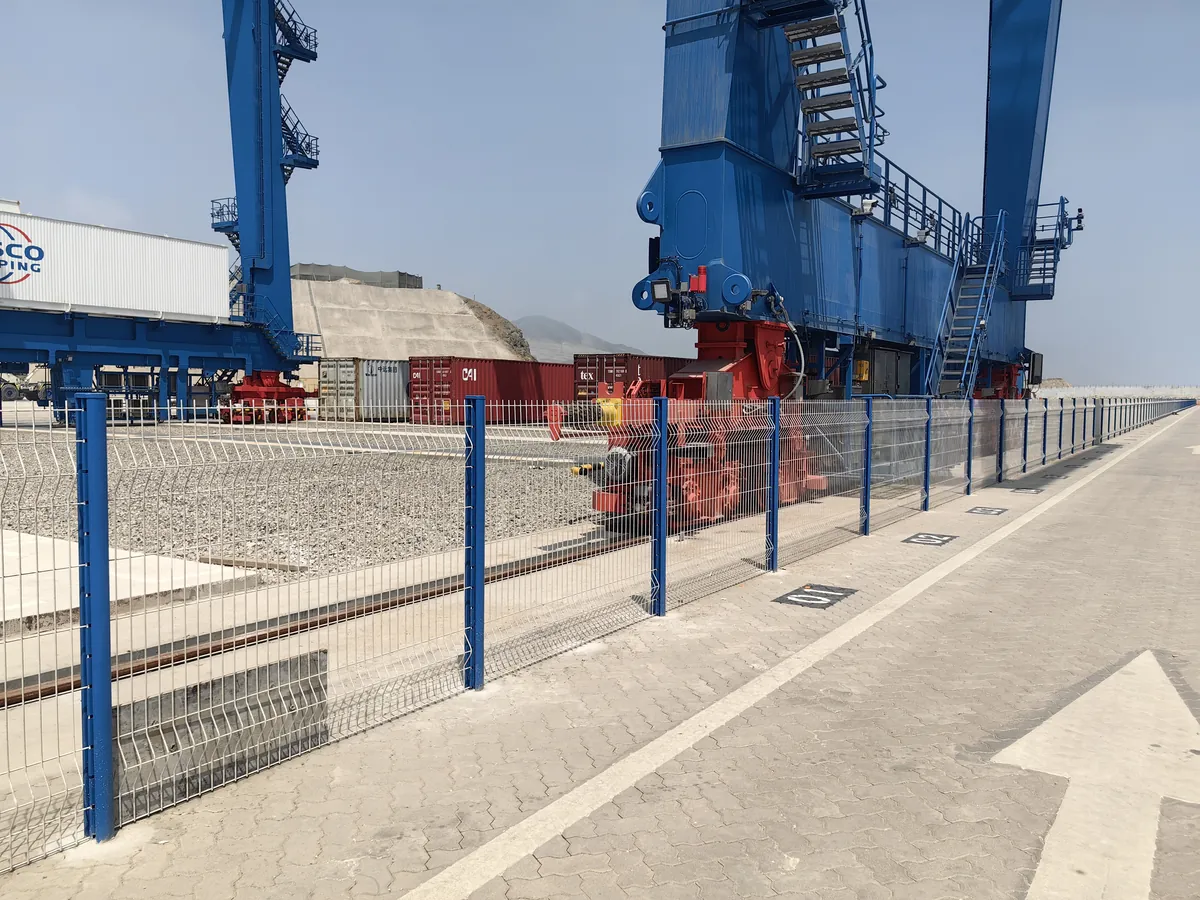
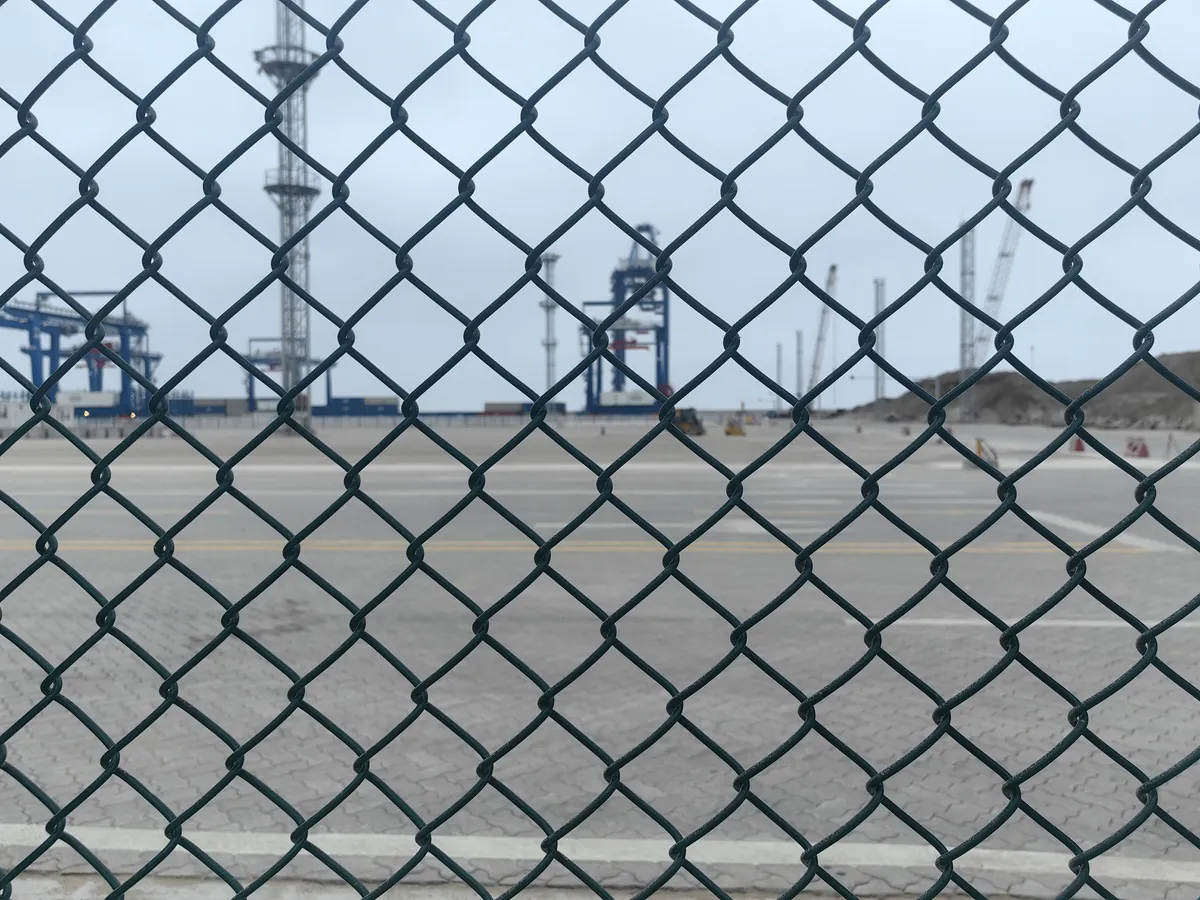
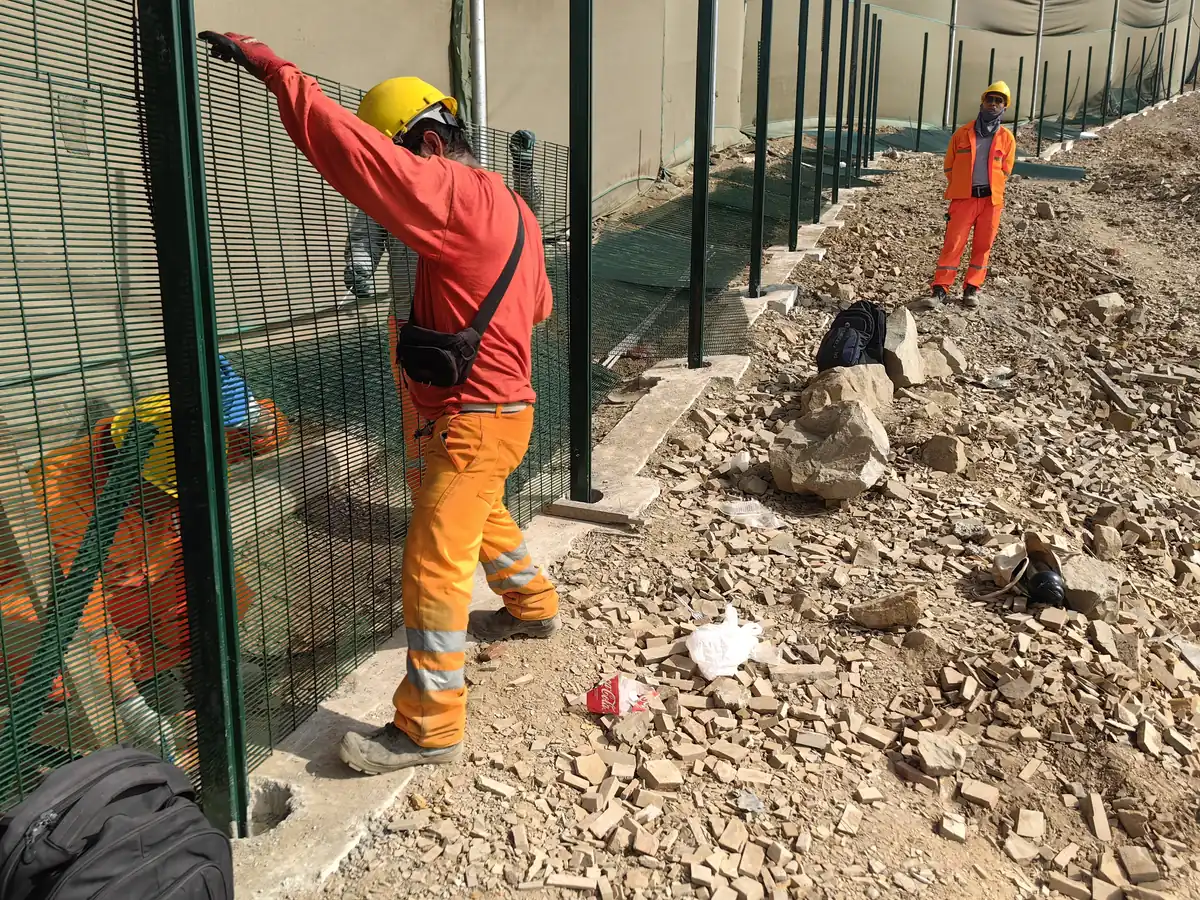
Chancay Port sits on the Pacific coast about 78 km north of Lima. It was developed by COSCO Shipping Ports and opened in November 2024. We supplied perimeter fencing for the terminal, including 3D V-mesh panel fence, 358 anti-climb fence and PVC-coated chain link fence. The site photos in this article were taken during visits in October and November 2024, shortly before the port opened.
Peru doesn’t get typhoons, but the salt air at Chancay is the same problem coastal sites in the Philippines deal with every day. A few details from that job carry over directly:
- The 358 panels were set on a continuous concrete kerb instead of separate post holes, which spreads the load and keeps the bottom of the mesh off wet ground.
- Different zones got different fences: anti-climb 358 where security matters most, 3D panels along the rail yard, and open chain link with a top rail across the wide yard areas where visibility matters.
- The welded panels and posts were hot-dip galvanized after welding and then electrostatic powder coated at our factory, so no coating work was needed on site.
Read the full case study: Chancay Port Fencing Project Solutions
6. Frequently Asked Questions
Is an open mesh fence better than a concrete wall in typhoon areas?
Not automatically. Open mesh catches less wind, but how either one performs depends on the structure, the footings and the site. Both should be designed to your local code.
Can I strengthen my existing fence instead of replacing it?
Often, yes. Replacing damaged posts, adding intermediate posts, upgrading the fixings or reinforcing footings can all help. Find out why it failed before deciding.
Is chain link suitable for typhoon-prone areas?
Chain link is very open and catches little wind. Our CLY chain link fence is hot-dip galvanized with an optional PVC coating. Its storm performance depends on the posts, tension wires, bracing and footings.
Is your 358 fence certified for 200 km/h winds?
A wind rating belongs to a complete fence system on a specific site, not to a panel on its own. Send us your design wind speed and site details and we will build the system around your engineer’s calculation, with heavier posts and closer spacing where they are needed. See the full 358 fence specification and buying guide.
How long is delivery to the Philippines?
Standard products are typically produced in about 30 days, depending on quantity and customization. We ship to Manila, Cebu, Davao and Subic; sea freight time depends on the port and sailing schedule, and we confirm it with every quotation.
What information do you need for a quotation?
Project location, total length, height, preferred mesh type (358 / 2D / 3D / chain link), surface finish, design wind data (if available) and destination port. A site plan or footing details helps us quote faster.
Blade
Project Sales Specialist, Command · 3 years in perimeter fencing
Blade works with contractors and developers on port, industrial and infrastructure fencing projects, from the first drawings to shipping. If you want to talk through a site, send him the location and fence length through the quote form below.
Get a Fence Specification for Your Typhoon-Prone Site
Planning a perimeter for an airport, port, industrial park, substation or logistics centre in the Philippines or another typhoon-prone market? Tell us your site location, fence length and height, and our engineering team will reply with recommended mesh, posts, connections, coating and a CIF quotation.
Request a Quote Chat on WhatsAppCommand (Hebei Command Metal Products Co., Ltd.) makes high-security perimeter fencing in Raoyang County, Hebei, and ships it to airports, seaports, industrial plants and infrastructure projects worldwide.


